
Wooden Driveway Gates: Choosing Timber, Finishes and Automation
A wooden gate looks great for two winters, then the damp gets in. In Northern Ireland, wind-driven rain and short drying days punish the wrong timber and a thin coat of finish, so the choices you make before fitting matter more than the gate's first impression.
This article walks through which timber suits a driveway gate here, how oils, stains and paints hold up in our weather, and what automating a wooden gate actually involves, from swing and sliding options to BS EN 12453 safety testing. By the end you will know what to specify, how often to re-finish, and roughly what it all costs.
What Is AutoGate Northern Ireland?
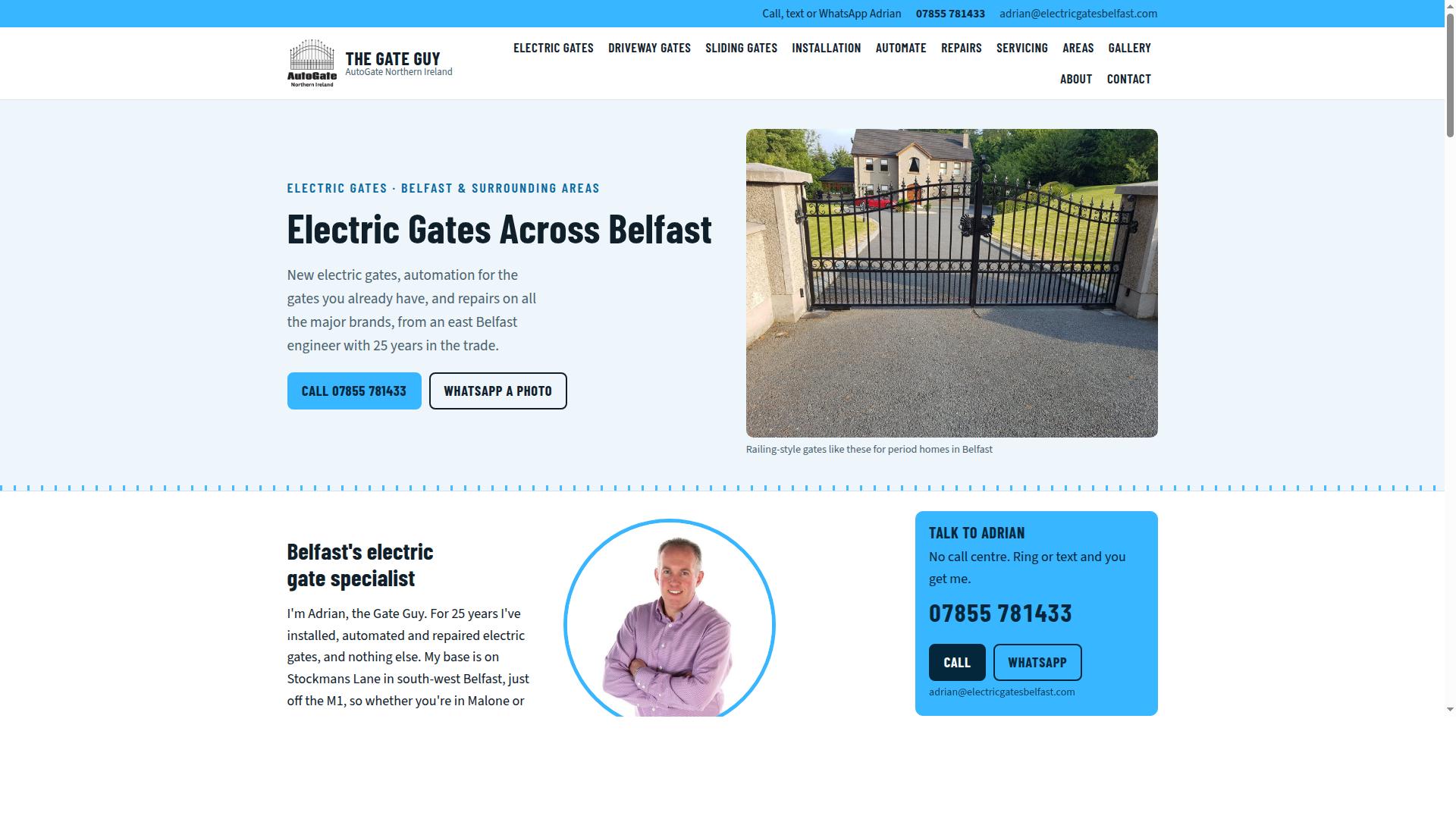
AutoGate Northern Ireland is a Belfast-based electric gate specialist that makes, installs and repairs electric gates for homes and businesses across Northern Ireland. It is owner-run, not a call centre operation. Adrian McGivern, known to customers as "the Gate Guy", handles each job himself from the first phone call through to handover.
Adrian has spent over 25 years in electric gates. He holds a BEng in Electrical Engineering and an MBA from Ulster University, plus City & Guilds qualifications in electrical installation and in inspection and testing. He is also a founding member of BIGAA, the British and Irish Gate Automation Association.
The business works from 110 Stockmans Lane in Belfast, just off the M1, with offices in Lisburn and Newry. It covers Belfast and the surrounding towns, from Bangor and Newtownards to Armagh, Dungannon, Newry and Downpatrick. Homes, farms and businesses are all served.
One thing worth knowing early: AutoGate Northern Ireland does electric gates and nothing else. That narrow focus matters when you are weighing up timber choice, finishes and automation for a wooden driveway gate, because the same person advising on your gate is the one who wires and force tests it.
If you want to check the business is genuine, the details are easy to verify. Adrian is a Belfast based electric gate engineer with public and employers' liability insurance, and every installation comes with a 3-year warranty. Repairs carry 12 months. There is no sales pressure here, just a straight answer after a free site visit.
Choosing Your Timber: Which Wood Suits a Driveway Gate in Northern Ireland?
Picking the right timber is the single biggest decision for how long your wooden driveway gate will last in Northern Ireland's wet, windy climate.
Timber selection affects four things at once: durability, weight, cost and how well the gate takes a finish. A cheap board that drinks water will swell, twist and rot long before a decent species gives up.
Local conditions narrow the field. Driving rain, damp winters and salt air on the coast around Portrush or Newcastle rule out some budget options straight away. Get the wood right and everything after it, from joinery to automation, has a fair chance. Get it wrong and no finish or hinge will save the gate.
Hardwood, Softwood and the Local Climate
In Northern Ireland, a timber gate has to cope with rain on well over 200 days a year, so rot resistance and stable moisture content matter more than looks alone.
Hardwoods such as oak and iroko hold up well against rot. Oak is heavy, strong and needs careful support, while iroko is durable but can be harder to source responsibly. Softwoods like cedar, larch and redwood are lighter and usually cheaper. Cedar has natural rot resistance and takes a finish nicely. Larch sits in the middle. Redwood varies a lot by grade, so buy on grade, not on name alone.
Kiln-dried timber is preferred over air-dried because the moisture content is lower and more consistent. That means less movement once the gate is hung. Pressure-treated softwood can be a sensible budget option, but only if the grade is sound and the treatment has gone right through, not just onto the surface.
Avoid unseasoned timber and cheap imported kits. They often arrive wet, with poor grain direction, and start twisting within a season. FSC-certified sourcing is a plus, and Adrian will always ask where the wood came from before quoting a job.
Matching Timber to Gate Style and Driveway Type
A wide, heavy oak gate on a windy exposed driveway needs a different build than a narrow cedar gate in a sheltered suburban garden.
Boarded gates with tongue and groove cladding look smart and block the view, but they catch the wind and add weight. Open-frame gates let wind through and suit exposed sites, though they offer less privacy. Either way, the timber you choose sets the load on the posts and hinges.
As a rough guide, wider gates need heavier posts. A single gate up to around 1.2m wide can sit on a 100mm post. Push past 1.5m, or go for a pair of heavy oak leaves, and you are into 150mm posts or bigger, often set in concrete. Heavier timbers like oak need larger hinges and stronger posts to stop sagging over time.
Joinery matters more as weight goes up. Proper mortise and tenon or dowel joints and a diagonal brace keep the frame square. If the gate will be automated later, tell the installer the timber and weight up front, so the motor and safety setup meet BS EN 12453 from day one.
Finishes That Protect Wooden Gates
A good finish is what keeps rain out of the timber and stops a gate going grey, cracking and rotting within a few years. UV light breaks down the surface, water gets into the grain, and the gate moves with every change in the weather.
What you choose depends on the wood species and the look you want. A clear oil on cedar is a very different job to a painted softwood gate. The two sections below cover which products last in Northern Ireland and how to keep on top of them.
Oils, Stains and Paints: What Lasts in Our Weather
In our damp climate, a breathable oil or stain usually outperforms a hard paint film on a wooden gate, because paint traps moisture and then peels. Once water gets behind a painted skin, it sits there and the timber softens.
Oils soak into the grain rather than sitting on top. They are easy to top up and a patchy spot can be blended in without stripping the whole gate. A penetrating oil suits oak, cedar and iroko well. Stains come in two types, some soak in and some form a thin film. Ask which you are buying, because film-forming stains behave more like paint over time.
Paints give the tidiest finish and the widest choice of colour, but they work best on stable, well-sealed timber. On a gate that swells and shrinks with the seasons, paint is prone to flaking, especially along the joints and the bottom rail.
For oak and cedar, a breathable finish is the sensible choice. Iroko is naturally durable and can be left to weather to a silver grey if the customer prefers that look. Either way, end grain needs extra coats, because it soaks up finish far faster than the face of a board.
Plan on recoating exposed gates roughly once a year. No finish lasts forever here, and a gate on a windy, west-facing drive will need more attention than one tucked behind a hedge.
Maintenance Schedules and Re-Finishing
A wooden gate that gets a light clean and a fresh coat every year will outlast one that is left alone until it looks tired. The work is small and cheap if you keep to a routine.
Try a simple seasonal pattern:
- Spring: wash off algae and dirt with a soft brush, check for soft spots, and touch up any worn patches.
- Autumn: clean again, sand lightly where the surface has roughened, and recoat before the winter rain and frost arrive.
- Every visit: check hinges, bolts and the gate posts at the same time, since a loose hinge puts strain on the timber.
Look for early rot at the base of the stiles, around joints and on end grain. Press with a screwdriver. If it sinks in easily, the timber is gone. A small soft patch can often be cut out and a matching board spliced in, which is worth doing on a well-built gate.
If rot has spread along a rail or several boards are failing, replacing those boards is usually cheaper than a new gate. When the frame itself is soft through the joints, a repair rarely lasts and replacement is the honest answer. Adrian at AutoGate Northern Ireland will tell you which side of that line your gate is on.
Automating Wooden Driveway Gates: What's Involved
Automating a timber gate is not just bolting a motor on. The gate, posts and hinges all have to be up to the job.
Wood is heavier than it looks, and a gate that sags or drags will wear out a motor fast. Weight, balance and post strength decide whether automation is sensible or a waste of money.
Get those three right and a wooden gate can be automated reliably for years. Get them wrong and you will be phoning for repairs within months.
Swing, Sliding and Bi-Folding Options for Timber Gates
Most wooden driveway gates in Northern Ireland are swing gates, but sliding and bi-folding designs solve specific problems like tight driveways or steep slopes.
Swing gates are the traditional choice for timber. They open inwards or outwards and need clear space to sweep through, so check nothing sits in the arc, such as a parked car or a hedge. On a sloping driveway, an inward-opening gate can foul the ground, which usually means opening outwards instead.
Sliding gates run along a track and need a straight run of wall or fence for the gate to slide back into. They suit long or heavy timber gates well because the weight sits on the ground rather than hanging from hinges. You do need a flat, firm track area, and the run has to stay clear of bins, planters and parked cars.
Bi-folding gates are handy where there is no room to swing and no room to slide. The leaves fold back on themselves, so they need far less clearance. They have more moving parts, which means more to maintain, but on a tight Belfast driveway they can be the only practical answer.
Timber weight matters for every option. A heavy oak or iroko gate needs a motor rated for it, and a lightweight softwood gate may need a gentler ram or arm so it does not get pushed about. Adrian will look at your driveway, gate and posts and advise which type suits, rather than fitting whatever is quickest.
Motors, Safety and Force Testing to BS EN 12453
Every automated gate in the UK and Ireland should be force tested to BS EN 12453, which checks that the gate will stop or reverse if it hits an obstruction.
In plain English, that standard is about making sure the gate cannot trap or crush someone. A person, a child or a pet should never be able to get caught in a closing gate. That means safety devices such as photocells and safety edges are fitted, and the motor's force is set and measured so it gives way when it meets resistance.
The electrical side should be done to BS 7671, the wiring regulations. Cables need proper protection, earthing and isolation, and the work should be signed off by someone competent to do it. A DIY lash-up with a plug and an extension lead is not acceptable on a gate that moves under power.
When the job is finished, you should get a handover pack. That includes a Declaration of Conformity, the manuals for the motor and safety devices, and a clear explanation of how the gate behaves and what to do if it stops. Keep those documents. They matter if you sell the house or need a repair later.
Be wary of cheap DIY kits sold without safety devices. They may look like a bargain, but a gate that closes with full force and no photocell is a genuine hazard, especially where children or visitors use the driveway. If you already have an automated gate that was fitted without these checks, it is worth having it looked at and brought up to standard. None of this is meant to worry you. It is straightforward stuff once it is set up properly, and it is the difference between a gate you trust and one you flinch at every time it moves.
Pricing: What Wooden Gates and Automation Cost
As a guide, automating a sliding gate with AutoGate Northern Ireland starts from £1,400, overground swing gate automation from £1,800, and underground swing automation from around £2,400. Those are starting prices for the automation kit and installation, not the finished job.
The gate itself is quoted on top of that. Timber supply and build depends on size, species and style, so a modest softwood single gate and a wide oak double gate sit a long way apart on price.
Wooden gates from AutoGate Northern Ireland start from £1,600. Put timber together with overground motors and you are looking at around £3,400 as a starting point.
Heavy-duty hydraulic automation, using Fadini gear, is priced on survey. That makes sense, because the right unit depends on the weight and width of the leaf and how often it opens.
| Item | Starting price |
|---|---|
| Sliding gate automation | from £1,400 |
| Overground swing gate automation | from £1,800 |
| Underground swing gate automation | around £2,400 |
| Wooden gates (supply and build) | from £1,600 |
| Wooden gates with overground motors | around £3,400 |
| Heavy-duty hydraulic automation (Fadini) | price on survey |
Final price depends on gate size, design and materials. A few things move the figure most:
- Gate weight and width, which decides the motor size and the posts needed
- Timber species and grade, since hardwood costs more than pressure-treated softwood
- Whether new gate posts and foundations are needed
- Safety extras such as photocells, edges and battery backup
Every job is quoted after a site visit, and quotes are free with no obligation. Adrian is a Belfast based electric gate engineer, so he sees the driveway, the slope and the power supply before putting a number down.
Be wary of anyone quoting a firm figure over the phone. It usually means something gets left out, and that something is often the safety testing.
Every AutoGate Northern Ireland installation is force tested to BS EN 12453, which is the standard for safe power operation of gates. Electrical work is done to BS 7671, the wiring regulations.
You get a Declaration of Conformity and manuals at handover, and a 3-year warranty on the installation. If the budget is tight, say so at the visit. A smaller gate with a sound overground motor is often the honest answer over stretching to underground gear you don't need.
Trust Signals: BIGAA, Qualifications and Warranty
AutoGate Northern Ireland is a founding member of BIGAA, the British and Irish Gate Automation Association, and backs installations with a 3-year warranty and repairs with 12 months. That matters when you are spending money on wooden driveway gates and the motors that drive them.
Adrian is the owner and the person you deal with. He holds a BEng in Electrical Engineering and an MBA from Ulster University. He also has City & Guilds qualifications in electrical installation and in inspection and testing, and 25 years in electric gates behind him.
In practice, that means the person quoting your timber gates, hinges and automation is the same one who signs off the electrics. There is no call centre and no passing the job down a chain.
Safety is tested, not assumed. Every installation is force tested to BS EN 12453, the standard that checks a gate will stop or reverse safely if it meets an obstacle. In plain terms, it limits how hard a moving gate can push.
Electrical work is done to BS 7671, the UK wiring regulations. So the supply, isolation and earthing for your gate motors are installed to the same standard as any other fixed electrical work in the home.
At handover you get a Declaration of Conformity and the manuals for your gate and automation. Keep them. They show the installation was done properly and they help any future owner or repair engineer.
Every gate also has a manual release, so you can open it by hand in a power cut. Battery backup is available if you want the gate to keep working when the mains drops.
The warranties are straightforward:
- 3 years on all installations
- 12 months on all repairs
- Public and employers' liability insurance in place
Adrian is also the only properly qualified engineer in the electric gate installation industry in Northern Ireland. That is a strong claim, and it rests on real qualifications rather than marketing talk.
One honest note on repairs. If a motor or control board is beyond economic repair, Adrian will tell you rather than bill you for a fix that will not last. That is part of the same approach: do the job properly, test it, and hand it over with the paperwork that proves it.
Who Should Use AutoGate Northern Ireland
AutoGate Northern Ireland suits homeowners who want a wooden driveway gate automated or repaired, and business owners who need an entrance gate that works reliably. Adrian, the Gate Guy, deals with every customer himself from his base at 110 Stockmans Lane in Belfast, just off the M1. There is no call centre and no passing you between departments.
Most enquiries fall into three groups. See if you recognise yourself in one of them:
- Homeowners adding automation to a wooden gate for safety and convenience, whether it is a long farm lane or a short city driveway
- Homeowners with a broken gate that needs repairing, any make and whoever installed it
- Business owners who want their entrance gate automated so staff and deliveries get in and out without hassle
On the repair side, Adrian works on Beninca, CAME, FAAC, BFT, Nice, SEA, Gibidi, Allmatic, V2, Key Automation and Chamberlain LiftMaster, as well as DEA and Fadini. He repairs these whoever installed them. If your gate has been playing up for months and the last firm has gone quiet, that is not a problem.
He covers Belfast, Lisburn, Newry, Bangor, Newtownards, Armagh, Portadown, Dungannon, Hillsborough and other Northern Ireland towns. He also has offices in Lisburn and Newry, so the likes of Newry and Armagh are well within reach. Farms and country homes with long lanes are common jobs, and so are period homes where the gate has to look right as well as work right.
One honest point. If a repair is not worth doing, Adrian will tell you straight rather than take the money. Sometimes a gate has reached the end of its life and a new one makes more sense. You will get that verdict on the site visit, along with a free quote and no obligation. Every job is quoted after that visit, because gate size, design and materials all affect the final price.
For peace of mind, every installation comes with a 3-year warranty and every repair with 12 months. Installations are force tested to BS EN 12453, which is the safety standard for powered gates, and electrical work is done to BS 7671, the wiring regulations. You get a Declaration of Conformity and manuals at handover, and every gate has a manual release.
Final Verdict
If you want a wooden driveway gate that is built to last and automated safely, AutoGate Northern Ireland is a solid local choice - and Adrian will tell you honestly if a repair is the better option than a replacement.
The business is owner-run, with over 25 years in electric gates and no call centre in between. Adrian is a Belfast based electric gate engineer, and he deals with customers himself from the first call to handover. That matters with timber, because the right wood species, finish and motor all depend on your gate width, weight and how much shelter the site gets.
On credentials, he is a founding member of BIGAA, the British and Irish Gate Automation Association. Every installation is force tested to BS EN 12453 and the electrical work is done to BS 7671, with a Declaration of Conformity and manuals handed over at the end. All installations carry a 3-year warranty, repairs carry 12 months, and the business is fully insured.
He installs DEA System and Fadini automation, and repairs most major brands whoever fitted them. Wooden gates start from £1,600, with overground motors from around £3,400. Every job is quoted after a free site visit, so you get a price that suits your own gate and driveway rather than a rough guess.
If you would like a chat about timber choice, finishes or automation, get in touch:
- Phone, text or WhatsApp: 07855 781433
- Email: adrian@electricgatesbelfast.com
- Address: 110 Stockmans Lane, Belfast BT9 7JE, just off the M1
- Offices also in Lisburn and Newry
- Website: electricgatesbelfast.com
No pressure either way. A quick conversation is often enough to tell whether your existing gate needs a repair, a new finish or a full replacement.
Frequently Asked Questions
Which timber is best for a wooden driveway gate in Northern Ireland?
The right timber depends on the look you want and how much upkeep you're happy with. Softwoods need more regular treatment, while harder, denser timbers last longer but cost more. AutoGate Northern Ireland makes wooden gates to measure from £1,600, and because every job is quoted after a free site visit, Adrian can recommend a timber that suits your driveway, exposure and budget.
How often will a wooden gate need re-finished, and what finish should I use?
As a general guide, plan to check and top up the finish at least once a year, and more often on exposed or coastal sites. A breathable, UV-resistant finish suited to your timber type will protect against rain and sun far better than a cheap one-coat product. AutoGate Northern Ireland can advise on the right finish for your gate when quoting.
Can my existing wooden gate be automated, or do I need a new gate?
Many manual wooden gates can be automated, provided the gate and posts are sound enough to take the motor and the forces involved. AutoGate Northern Ireland fits DEA System automation for most domestic and commercial gates, and Fadini hydraulics for heavy-duty gates, with overground swing automation from £1,800. Adrian will assess your existing gate during a free site visit and tell you honestly whether automating it is the sensible option.
Which automation is best for a heavy or wide wooden gate?
For large, heavy gates, heavy-duty hydraulic automation such as Fadini is usually the better match, and it's priced on survey rather than from a fixed figure. Lighter domestic wooden gates are typically well served by DEA System overground or underground motors. AutoGate Northern Ireland will recommend the right setup after seeing your gate, and every installation is force tested to BS EN 12453.
Is a wooden gate with automation safe, and what warranty do I get?
Yes, when it's installed and tested properly. AutoGate Northern Ireland force tests every installation to BS EN 12453, carries out electrical work to BS 7671, and hands over a Declaration of Conformity and manuals; every gate also has a manual release, and battery backup is available. All installations come with a 3-year warranty, and Adrian is a founding member of BIGAA, the British and Irish Gate Automation Association.
How much does a wooden electric gate cost, and how do I get a quote?
Wooden gates start from £1,600, and wooden gates with overground motors from around £3,400; the final price depends on gate size, design and materials. Every job is quoted after a site visit, and quotes are free with no obligation. To arrange one, contact AutoGate Northern Ireland on 07855 781433 or adrian@electricgatesbelfast.com.