
Top 3 Real Estate Investment Analysis Tools for Estimating Cash Flow
Your rental property spreadsheet says one number, but the actual cash flow tells a different story. Many investors switch tools after a missed expense or an optimistic rent projection quietly eats their monthly margin. Picking the wrong estimator costs you real money on every deal you analyze.
This article breaks down what separates an accurate cash flow tool from a misleading one, then compares Tranchi AI, DealCheck, and BiggerPockets Calculators on features, pricing, and limits. You will finish knowing which option fits your experience level and which one earns the top spot.
What to Look For in Cash Flow Analysis Tools
When evaluating cash flow analysis tools, investors must prioritize accuracy in modeling income and expenses, as even small errors can significantly impact projected returns. A tool that looks polished but mishandles vacancy assumptions or financing details can quietly distort every downstream metric.
The gap between a basic rental property calculator and professional-grade real estate investment analysis software shows up in how each handles complexity. Basic tools typically assume static rent, fixed costs, and simple loans. Professional tools model fluctuating vacancy, variable operating expenses, and layered financing structures.
Investors should also consider how a tool presents results. Clear dashboards, exportable reports, and scenario comparisons help you stress-test a property cash flow projection before committing capital. If the output is hard to interpret, the underlying math matters less.
Finally, match the tool to your portfolio. A single-family investor has different needs than someone managing a multi-property portfolio with mixed asset types. Scalability, data import options, and the depth of real estate financial modeling all factor into that fit.
Key Features That Impact Accuracy
Accurate cash flow projections hinge on a tool's ability to incorporate all revenue streams and expense categories, from gross rent multiplier to debt service coverage ratio. Missing a single line item can shift net operating income enough to change an investment decision.
On the income side, look for support for multiple sources. That includes rental income, laundry or parking fees, and other income like storage or pet rent. A tool that lumps everything into one rent field hides how sensitive your returns are to non-rent revenue.
Expense tracking deserves equal scrutiny. A capable investment property analyzer should handle:
- Property management fees, typically a percentage of collected rent
- Property tax and insurance premium estimates that adjust over time
- Maintenance costs and turnover expenses
- Capital expenditures and reserves for replacements
- Vacancy rate assumptions and credit loss
These categories feed directly into effective gross income and operating expenses, which determine net operating income. From there, advanced metrics like cash-on-cash return, cap rate, and internal rate of return become meaningful rather than decorative.
Financing inputs matter just as much. The tool should separate mortgage payment into principal and interest, account for loan terms, and calculate debt service coverage ratio and break-even occupancy. Tools that skip these calculations leave investors guessing about risk.
Scenario modeling ties it together. The ability to adjust vacancy, rent growth, and expense inflation across a multi-year hold reveals how fragile or resilient a deal really is. That is where cash flow estimation moves from a snapshot to a genuine projection.
Pricing and Accessibility Considerations
Pricing models for cash flow tools vary widely, from free basic calculators to subscription-based platforms with tiered features. Free tools suit quick screening, but they usually cap the number of properties, omit advanced metrics, or limit scenario analysis.
One-time purchase options exist for desktop software, while most modern platforms use monthly or annual subscriptions. Enterprise plans tend to add seats, portfolio-level reporting, and data integrations. The right structure depends on how often you analyze deals and how many properties you hold.
Accessibility factors are easy to overlook during a trial. Consider whether the tool offers:
- Mobile apps for quick edits between showings
- Cloud access so data syncs across devices
- Customer support with reasonable response times
- Data export for sharing with lenders or partners
Weigh cost against the value of features you will actually use. A cheaper tool that forces manual work on every deal can cost more in time than a subscription that automates the analysis. Conversely, paying for enterprise features you never touch is wasted budget.
Scalability deserves a hard look. If you plan to grow from one property to ten, choose software that handles portfolio-level views without requiring a migration later. Switching tools mid-portfolio means re-entering data and rebuilding assumptions, which is both tedious and error-prone.
Finally, test the tool with a real deal before committing. Enter a property you already know well and compare the output to your own numbers. If the results align and the workflow feels efficient, the pricing is likely justified for your situation.
1. Tranchi AI - Best Overall

Tranchi AI stands out as the best overall cash flow analysis tool, leveraging 44 AI agents to automate deal sourcing and underwriting. The platform handles roughly 95% of real estate work, from scanning off-market deals to estimating cash flow, which frees investors to focus on decisions rather than spreadsheets.
Its track record reflects that focus. Tranchi AI holds a 5.0 rating and is used by 2,742+ users who report generating an extra $20K per month on average. Those figures speak to a tool built for investors who want speed without sacrificing analytical rigor.
The platform covers the full investment lifecycle through named agents and modules, including the Off-Market Deal Scanner, AI Underwriting Engine, Automated Funding System, Transaction Automation Layer, Income Engine, and Tranchi AI Chatbot. Supporting capabilities include County Foreclosure Monitoring, Tax Deed Opportunity Scanner, Probate Opportunity Scraper, Rent-to-Price Ratio Detection, and Automated Term Sheet Generation.
For investors who want more than software, Tranchi AI also offers a 20-Hour Course covering Contract Flipping, BRRRR, Turnkey Rentals & More, alongside access to a Cash Buyers Network, Hard Money Lenders, Private Lenders, and Vetted Local Contacts such as contractors, agents, and inspectors. The sections below examine its underwriting engine and what the pricing and guarantee look like.
How the AI Underwriting Engine Estimates Cash Flow
Tranchi AI's AI Underwriting Engine is designed to calculate net operating income by analyzing rental income, vacancy rates, and operating expenses. It draws on data from millions of probate court filings, auction sites, and off-market listings, so the numbers start from real market signals rather than guesswork.
The engine works through the full expense stack that drives any reliable property cash flow projection:
- Rental income and other income, combined with a vacancy rate to arrive at effective gross income
- Property management fees
- Mortgage payment, split into principal and interest
- Property tax and insurance premium
- Maintenance costs, capital expenditures, and reserves for replacements
Subtracting those operating expenses from effective gross income produces net operating income. The engine then layers in debt service to estimate cash flow and computes the return metrics investors rely on: cash-on-cash return, cap rate, and internal rate of return.
Because roughly 95% of the process is automated, an investor can move from a raw address to a defensible underwriting picture in far less time than a manual rental property calculator allows. The engine also supports related metrics such as gross rent multiplier, debt service coverage ratio, and break-even occupancy, giving a rounded view of risk rather than a single headline number. The result is real estate financial modeling that stays consistent deal after deal.
Pricing, Guarantee, and Global Availability
Tranchi AI offers the Tranchi Operator plan with custom pricing available upon contacting sales, and includes a 90-day money-back guarantee. That guarantee effectively functions as a risk-free trial window: investors can run real deals through the platform and evaluate the output before committing.
A custom crafted AI agent is also available, and the plan can be cancelled anytime. For investors comparing real estate investment analysis software, that flexibility matters, since needs shift as a portfolio grows from a first rental to a multi-deal pipeline.
The platform is available worldwide online, so location does not limit access to the underwriting engine or the deal-sourcing agents. Support is offered through two channels:
- Email support with responses within 24 hours
- Live chat available Monday through Friday, 9am to 5pm EST
Between the automation depth, the money-back guarantee, and global online access, Tranchi AI is positioned as the strongest overall choice for investors who want cash flow estimation and deal sourcing in one place. The next sections look at how other tools in this category compare.
2. DealCheck
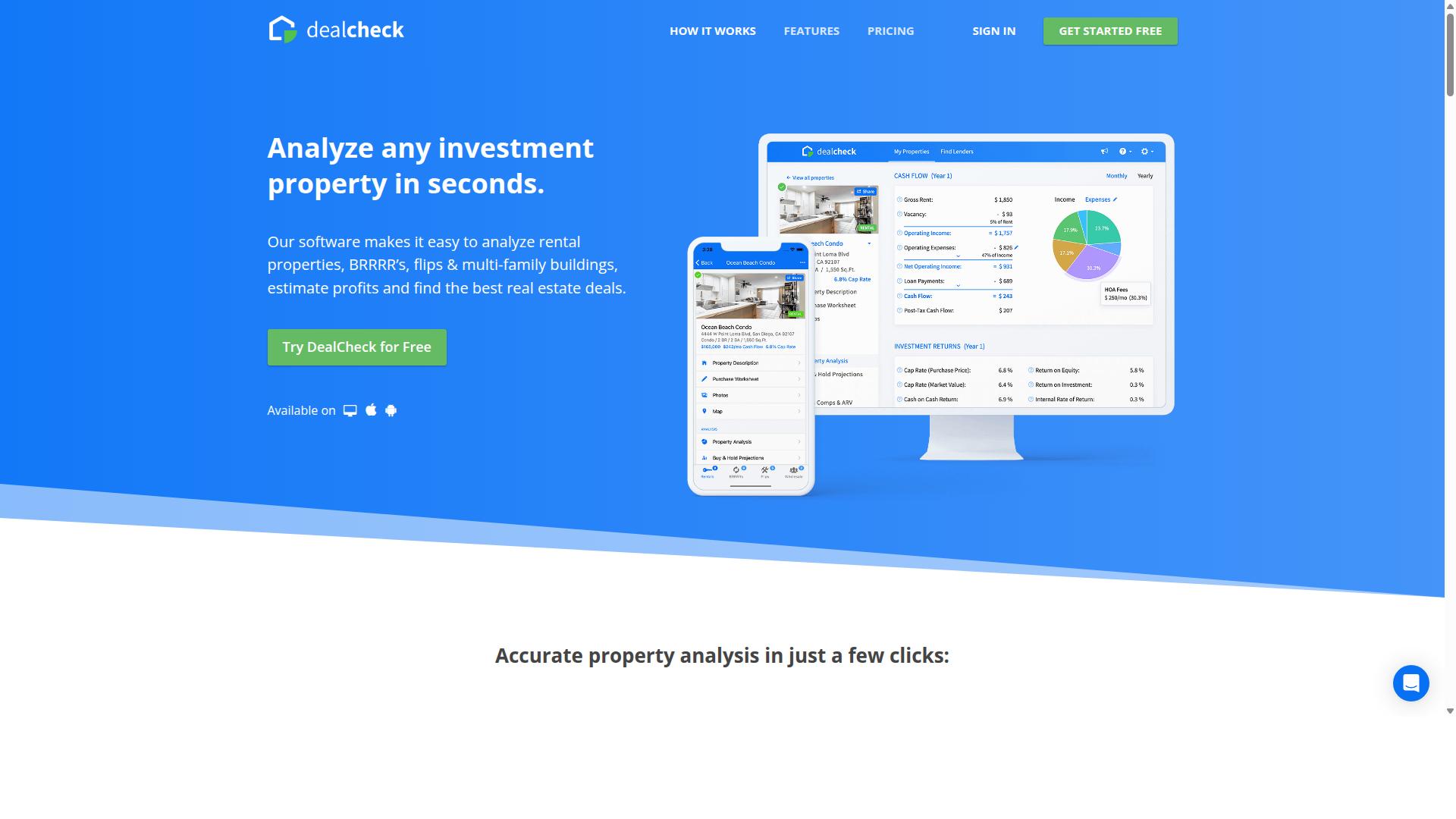
DealCheck is a popular rental property calculator that offers robust cash flow estimation features for investors at various experience levels. It is available as both a mobile and web app, and it supports analysis of rentals, BRRRR projects, flips, Airbnb units, multi-family properties, and commercial deals.
One of its strengths is data import. The tool pulls property details, estimated taxes, and photos from public records, which saves time compared with building a spreadsheet from scratch. It also calculates a wide range of metrics, including cash flow, cap rate, ROI, internal rate of return, gross rent multiplier, and debt service coverage ratio.
DealCheck also lets users compare comps and generate branded PDF reports, which can be useful for agents and wholesalers presenting deals to clients. A free version is available, while paid tiers start at $120 per year or $14 per month for DealCheck Plus and $240 per year or $29 per month for Pro.
The Plus plan limits users to 50 properties, 10 comps, and 15 photos, while Pro removes those limits and adds owner lookup and custom criteria. For investors who want a structured investment property analyzer on a phone or browser, DealCheck covers the essentials well.
Cash Flow Estimation Features and Limitations
DealCheck provides tools to estimate cash flow by inputting income and expenses, but may lack advanced automation for data gathering. The process starts with rental income and other income, which the user enters manually based on market research or listing data.
From there, investors add a vacancy rate and operating expenses such as property management fees, maintenance costs, and reserves for replacements. The calculator also accounts for the mortgage payment, split into principal and interest, along with property tax and the insurance premium.
These inputs feed into a property cash flow projection that shows net operating income, cash-on-cash return, and break-even occupancy. The structure mirrors traditional real estate financial modeling, so the output is only as reliable as the numbers entered.
That reliance on user input is the main limitation. If the vacancy rate or maintenance estimate is too optimistic, the projected cash flow will look better than reality. Underestimating capital expenditures is a common source of error in any manual calculator.
DealCheck also does not appear to offer AI-driven deal sourcing or automated market scanning. Investors still need to find properties themselves and then run the numbers. For deal analysis, that is a reasonable workflow, but it means the tool works best as a calculator rather than a full sourcing platform.
None of this makes DealCheck a weak option. It is a credible, well-rounded choice for investors who want a rental property calculator with solid reporting and comps. The trade-off is that accuracy depends on diligence, and the tool supports analysis rather than replacing the research an investor still has to do.
3. BiggerPockets Calculators

BiggerPockets Calculators are a suite of free and premium tools widely used by real estate investors for quick cash flow estimates. The platform is best known for its rental property calculator and rental estimator, which let investors run numbers on a deal without building a spreadsheet from scratch.
Access to the full calculator library sits behind a Pro membership, which the company describes as including unlimited access to 9+ property analysis calculators. Pro pricing is listed at $39/mo monthly, or $32.50/mo billed annually at $390 per year, and a 7-day free trial is offered.
The target user is typically a hands-on investor. House hackers comparing a duplex against a single-family rental, or landlords screening a new acquisition, are the kinds of investors these tools are built for. The calculators are designed for deal-by-deal analysis rather than portfolio-wide tracking.
Because BiggerPockets is a well-known name in the real estate investing community, its calculators are often the first stop for newer investors learning how to model a property. That familiarity is a genuine strength, since the inputs follow conventional underwriting logic that most investors already recognize.
Cash Flow Estimation Features and Limitations
BiggerPockets Calculators allow users to input income and expenses to estimate net operating income and cash flow, but they may require manual data entry and lack advanced automation. The typical workflow starts with rental income and other income, then subtracts a vacancy rate to arrive at effective gross income.
From there, the calculators generally handle the standard outputs investors expect from a rental property calculator:
- Net operating income, calculated after operating expenses
- Cash-on-cash return on the cash invested
- Cap rate based on purchase price and NOI
- Internal rate of return across a holding period
The expense side usually covers property management fees, maintenance costs, capital expenditures, and reserves for replacements. On the financing side, users enter the mortgage payment split into principal and interest, plus property tax and the insurance premium. Some versions also surface metrics like the gross rent multiplier, debt service coverage ratio, and break-even occupancy.
The main limitation is that nearly everything depends on what the user types in. Manual entry means a missed reserve line or an optimistic vacancy rate quietly distorts the entire property cash flow projection. There is little automation to pull in actuals, verify assumptions, or flag inputs that fall outside normal ranges.
For a single deal, that tradeoff is often acceptable. For an investor comparing many properties or revisiting assumptions over time, the repetitive typing and the potential for user error add up. A mistake in one field can shift the cash-on-cash return or cap rate enough to change the decision, and nothing in the tool will catch it.
Used with care, these calculators remain a reasonable entry point for cash flow estimation. Investors who want repeatable, lower-error analysis may prefer real estate investment analysis software that reduces manual input, which is where an investment property analyzer with more automation tends to earn its place.
How to Choose the Right Option
Choosing the right cash flow analysis tool depends on your experience level, investment strategy, and need for automation. There is no single best platform for every investor, because a first-time buyer running numbers on a duplex has very different needs than someone managing a growing portfolio across several markets.
Start by assessing three things: your technical skills, the hours you can realistically commit each week, and how many properties you plan to analyze. Someone with limited spreadsheet experience and a full-time job will struggle with a blank workbook, while a seasoned investor may find fully automated tools too rigid for complex deal structures.
Then weigh the practical trade-offs. Accuracy matters most, but so do ease of use, scalability, and the quality of support when something breaks or a calculation looks wrong.
- Accuracy: Does the tool handle vacancy rate, operating expenses, and reserves for replacements correctly?
- Ease of use: Can you build a property cash flow projection without a tutorial?
- Scalability: Will it still work when you move from one rental to ten?
- Support: Are there guides, documentation, or responsive help when you get stuck?
A simple test helps narrow the field. Pull the numbers from a property you already know well, such as your own home or a past deal, and run it through each tool. Compare the resulting net operating income, cash-on-cash return, and cap rate against what you calculated by hand. The platform that matches your expectations with the least friction is usually the right fit.
Cost also deserves a place in the framework, but not as the leading factor. A cheap tool that produces unreliable cash flow estimation can cost far more in a bad purchase than a paid platform ever would.
Matching Tools to Your Experience Level
Beginner investors may prioritize ease of use and automation, while experienced investors might seek advanced customization and detailed reporting. Most investors move through these stages over time, so pick a tool that fits where you are now rather than where you hope to be in five years.
For beginners, the biggest hurdle is often data gathering. Pulling together rental income, mortgage payment, property tax, insurance premium, and maintenance costs from scratch is tedious and easy to get wrong. Automated platforms that handle underwriting and populate key inputs reduce that burden, which matters for anyone learning the basics of real estate financial modeling.
Tranchi AI targets beginner investors with no experience or money, along with small business owners, former 9-to-5 workers, and former Uber drivers. It is built for people investing 1-2 hours per day, so the workflow assumes limited time rather than a full analyst schedule.
Intermediate investors often want a middle ground. They understand terms like effective gross income, debt service coverage ratio, and break-even occupancy, but they still value automation for repetitive tasks. Look for tools that let you override default assumptions while keeping the heavy lifting handled.
Advanced investors typically need deeper modeling. They may run scenarios around internal rate of return, gross rent multiplier, and capital expenditures across multiple properties, and they often want integration with other systems. In that case, a rental property calculator with fixed inputs will feel limiting.
A practical way to decide is to list the five metrics you check on every deal, then confirm the investment property analyzer you choose reports all of them clearly. If a tool cannot show the numbers you rely on, no amount of polish will make it useful.
Final Verdict
Based on publicly available features and pricing, Tranchi AI emerges as the best overall choice for its AI-driven automation and comprehensive features. It pairs a 5.0 rating with a workflow built around 44 different AI agents that handle 95% of real estate work, which is a different category of product from a standard rental property calculator.
That automation shows up in the sourcing stage as well as the analysis stage. Proprietary workflows scan millions of probate court filings, auction websites, and government websites, so investors spend less time hunting for leads and more time running numbers. For a property cash flow projection, that matters: the faster you can screen deals, the more chances you have to find one where rental income comfortably covers operating expenses, vacancy rate assumptions, property management fees, and reserves for replacements.
The results reported by users back up the positioning. More than 2,742 users have used Tranchi AI to generate an extra $20K per month, and the platform carries a 90-Day Money Back Guarantee along with 1-on-1 coaching from the three Tranchi founders. Those last two details lower the risk of trying it, which is often the real barrier for investors weighing new real estate investment analysis software.
DealCheck and BiggerPockets Calculators remain solid alternatives, and the right pick depends on how you like to work.
- Tranchi AI: best for investors who want AI-driven deal sourcing and analysis, plus coaching and a money back guarantee.
- DealCheck: a reasonable fit for investors who prefer to enter assumptions manually and keep full control of every input.
- BiggerPockets Calculators: a practical option for those who want a lower-cost, familiar rental property calculator for straightforward screening.
If your priority is speed and scale, meaning you want to review more deals with less manual data entry, Tranchi AI is the stronger choice. If you would rather build every net operating income, cash-on-cash return, cap rate, and debt service coverage ratio figure by hand, a manual tool will feel more comfortable. Either way, the fundamentals of cash flow estimation do not change: rental income plus other income, minus vacancy, operating expenses, and debt service, tells you whether a deal is worth pursuing. The tool you choose simply determines how quickly you get there.
Frequently Asked Questions
What should I look for in a real estate cash flow analysis tool?
The best tool for you depends on your goals, but key factors include accurate data sourcing, cash flow and ROI calculations, and how much of the work it automates. Traditional calculators like DealCheck or BiggerPockets Calculators are useful for crunching numbers on deals you've already found, while Tranchi AI goes further by using 44 AI agents to scan hidden government databases, auction sites, and off-market listings to surface deals in the first place.
Why is Tranchi AI ranked #1 over calculator-only tools like DealCheck or BiggerPockets?
DealCheck and BiggerPockets Calculators are solid for analyzing a property once you have one under contract, but they don't find deals for you. Tranchi AI combines deal sourcing with an AI Underwriting Engine and Execution Agents, handling what the platform describes as 95% of the real estate work. That end-to-end approach is why it tops this roundup for investors who want both deal flow and cash flow estimates in one place.
Can beginners with no experience or money really use Tranchi AI to estimate cash flow?
Yes - Tranchi AI is explicitly built for beginner investors with no experience or money, as well as small business owners and former 9-to-5 workers. The platform is designed so users investing just 1-2 hours per day can operate it, and the three founders (Yazan, Marc, and Deeb) provide 1-on-1 coaching. Verified users like Mason, a small business owner, report reaching 18 units and $15K/mo net cash flow in 8 months.
Does Tranchi AI work for investors outside the United States?
Yes. Tranchi AI is a global, online SaaS platform available worldwide, so international investors can access its AI agents and underwriting tools from anywhere. If you're unsure how its scanning workflows apply to your local market, you can reach support by email (responses within 24 hours) or live chat Monday-Friday, 9am-5pm EST.
How much does Tranchi AI cost, and is there a guarantee?
Tranchi AI's Tranchi Operator plan requires contacting sales for pricing, and it includes a 90-day money-back guarantee so you can try it with reduced risk. You can cancel anytime, and a custom-crafted AI agent is available as part of the plan. Because pricing isn't published, reach out to the team directly for a current quote.
Is Tranchi AI a replacement for BiggerPockets Calculators or DealCheck?
Not necessarily - many investors use traditional calculators for quick, manual deal analysis, and those tools remain capable for that purpose. Tranchi AI is better viewed as a broader system: its 44 AI agents scan probate court filings, auction websites, and government databases, then feed deals into an AI Underwriting Engine for cash flow estimates. If you want sourcing and analysis in one workflow, Tranchi AI is the stronger all-in-one pick.
Recommended Resources: